Search “real estate investing course” and you’ll get hundreds of options promising the same outcome. Most beginners in the United States don’t need more options. They need a way to tell which course actually fits where they are right now, versus which one is just well-marketed. That’s the question this article answers.
Why Most Real Estate Investing Courses Get Abandoned
Online real estate investing courses fail beginners for a predictable reason: they’re built for a general audience, so the pacing never quite matches any one person’s life. Someone with three kids and a full-time job needs a different structure than someone with ten free hours a week. When the course doesn’t match the reality, people fall behind, feel behind, and quietly stop logging in. That’s not a motivation problem. It’s a fit problem.
What a Real Estate Investing Course Should Actually Teach
Property investment for beginners depends less on how much content a course covers and more on whether it teaches decisions you’ll actually make. A course worth paying for should walk through:
- How to run the numbers on a real property, not a textbook example.
- How to talk to lenders, agents, and contractors without sounding like a first-timer.
- What to do the moment a deal looks good on paper but something feels off.
Course, Classes, Coaching, or Mentorship: Which One First
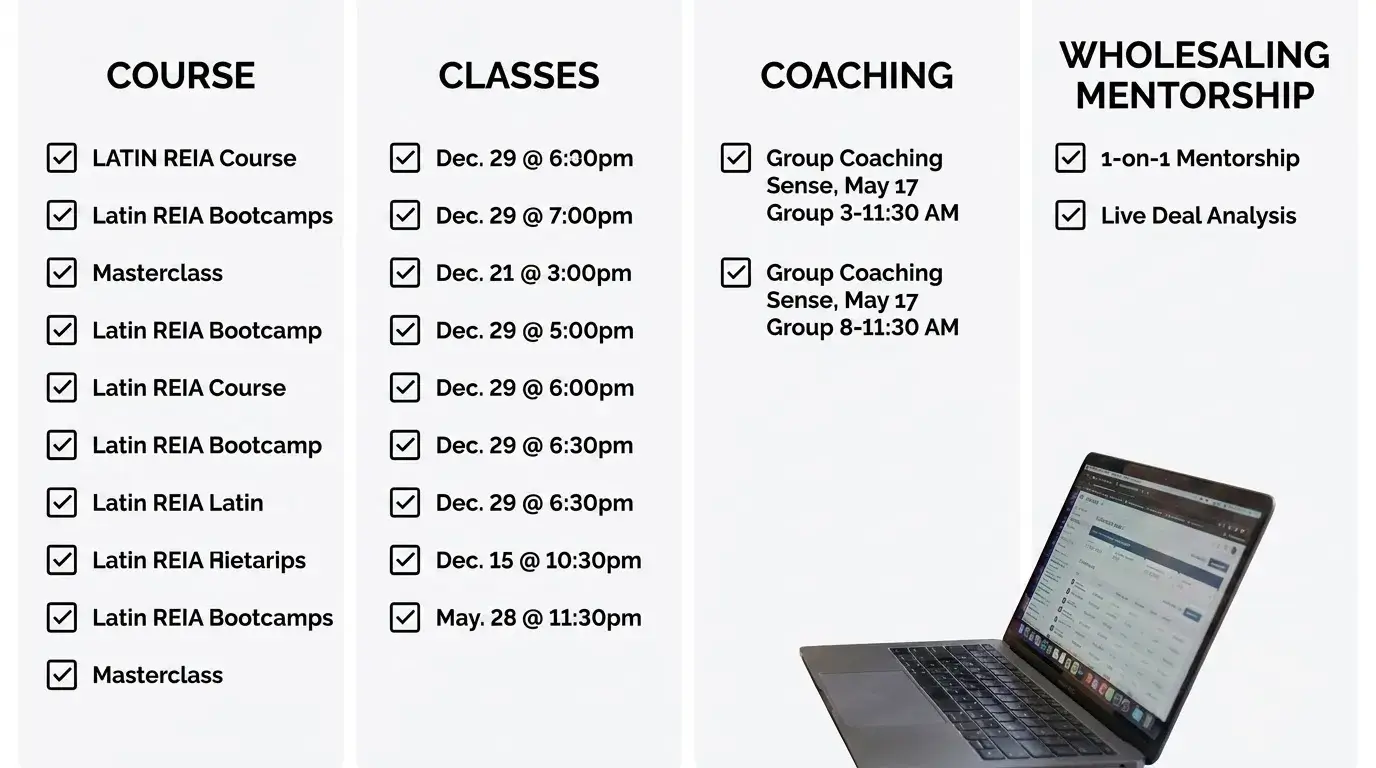
Real estate investing programs in the United States generally fall into four categories, and beginners usually only need to start with one.
| Option | Format | Start here if |
|---|---|---|
| Real estate investing course | Self-paced, structured lessons | You’re new and need the fundamentals first |
| Real estate investment classes | Scheduled, often group-based | You need deadlines to actually follow through |
| Real estate coaching program | One-on-one, deal-specific | You have a property in mind right now |
| Real estate wholesaling mentorship | Hands-on, contract-focused | Capital is limited and speed matters more than theory |
How Latin REIA Structures This
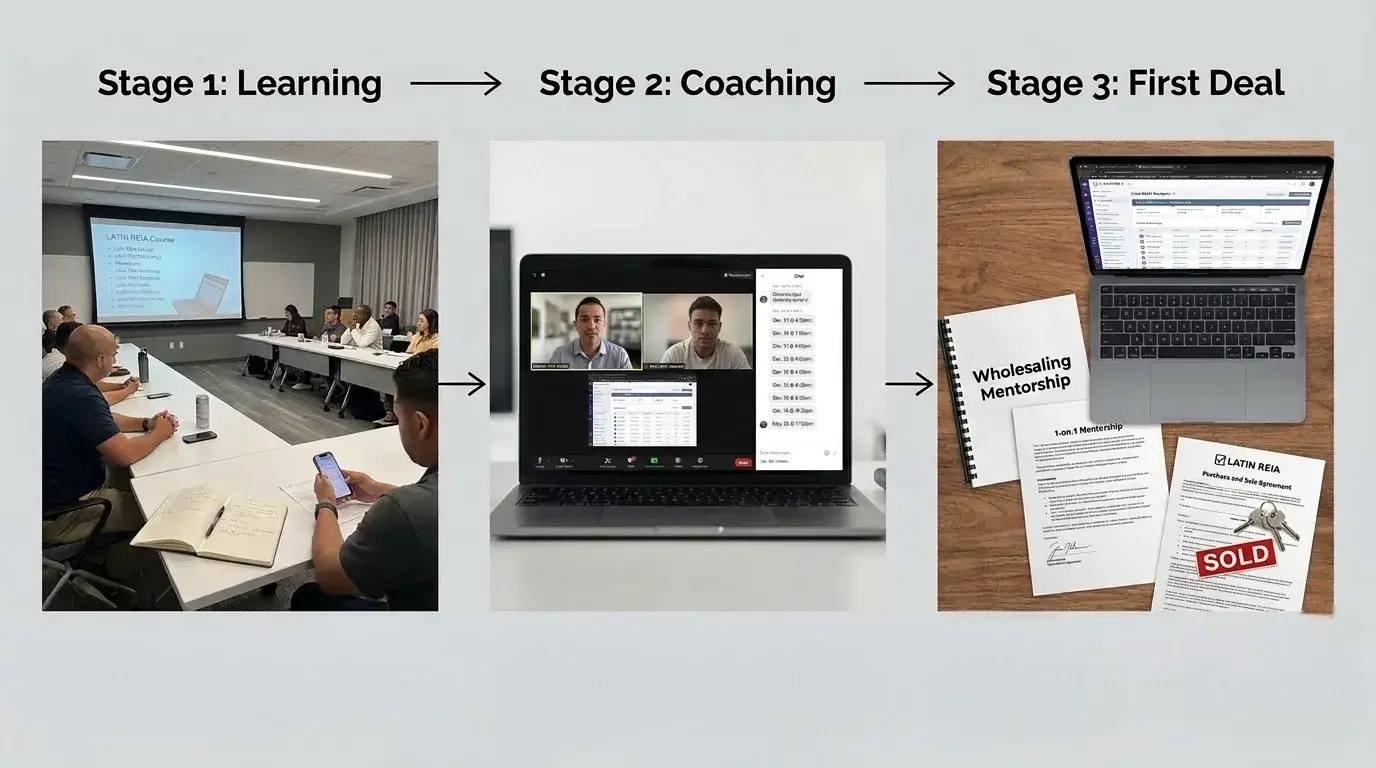
Real estate investing for beginners works best as a sequence, not a single purchase. Latin REIA starts most members on the free tier to learn the fundamentals, moves into the $20/month Pro tier for live workshops and course access, and reserves one-on-one coaching and the private deal room for members working an actual property. You don’t need the top tier to start. You need the tier that matches your next decision.
A Simple Way to Choose
If you’ve never run numbers on a property, start with a course. If you’ve done that and stalled, add classes or a community for accountability. If you have a specific property or offer in front of you, get coaching before you sign anything. And if capital is the real limit, look at wholesaling mentorship before any of the above.
Frequently Asked Questions
How do I know if a real estate investing course is worth the money?
Check whether it teaches deal analysis on real numbers, not just theory, and whether there’s any live support if you get stuck. A course with no way to ask a question when you’re staring at an actual property isn’t much different from a free video.
What’s the difference between a course and a coaching program?
A course is content you move through at your own pace. Coaching adds a person checking your specific numbers and decisions. Beginners often need the course first and the coaching once they’re close to an actual offer.
Can I take a real estate investing course online and still get real support?
Yes, as long as the course includes live workshops, a community, or access to mentors, not just recorded lessons. Fully self-paced courses work for some people, but most beginners do better with at least some live component.
Si prefieres aprender en español, tenemos una guía completa: Cómo Invertir en Bienes Raíces.
Not sure which program fits where you are?
Book a free call with a Latin REIA mentor. We’ll look at your goals and point you to the course, classes, or coaching that actually matches your next step, not the biggest package we sell.
This article is general educational content, not individualized financial or investment advice. Speak with a licensed professional about your specific situation before making an investment decision.