
Most people who search for a real estate investing course in Florida have already bought one course before. Sometimes two. And they’re back searching again because the first one taught them terminology without teaching them what to actually do with it. That’s the gap we hear about constantly at Latin REIA, and it’s the reason this article exists, to tell you what a course needs to cover before it’s worth your time.
The Problem with Most Generic Courses
A lot of national real estate courses are built once and sold everywhere. Same slides in Ohio as in Miami. That works fine for the parts of investing that don’t change by location such as how a mortgage amortizes, what cash-on-cash return means, and the basic maths behind a rental property. It falls apart the moment you get to anything specific to where you’re actually buying.
And Florida is not a state where you can skip the local details. Insurance alone can make or break a deal here in a way it simply doesn’t in most of the country. We’ve watched investors run numbers off a national course template, get excited about a property, and then get blindsided by an insurance quote that erased half their projected cash flow. Nobody taught them to check that first, because the course wasn’t built for Florida.
What a Florida-Specific Course Should Actually Cover
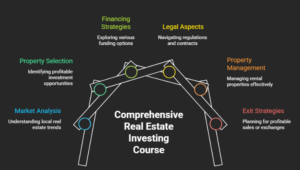
Deal Analysis Using Florida Numbers
A good course doesn’t just teach you the formula for cap rates, it walks you through what a realistic cap rate looks like in Broward versus Palm Beach versus a smaller inland Florida market, because those numbers aren’t interchangeable. Generic courses teach the math, while Florida-specific ones teach you what to plug into it.
Financing Options Available to Florida Investors
Most courses list conventional loans, DSCR loans, hard money, private money, seller financing and move on. What actually matters is which ones are realistic for your situation and your target property type, and which lenders in Florida are actually working with investors right now rather than just agents.
Property Insurance and Florida-Specific Risk Factors
Flood zones, wind mitigation requirements, hurricane deductibles are all important if you’re investing in Florida. A course that treats insurance as a footnote is a course built for somewhere else.
Legal and Landlord-Tenant Basics in Florida
Florida’s landlord-tenant law has its own quirks around security deposits, notice periods, and eviction procedures. This isn’t a substitute for talking to an attorney when you actually need one, but a good course gives you enough of a foundation that you know what questions to ask and what red flags to watch for in a lease.
Course Content vs. Live Support: Why Both Matter
Here’s something we’ve noticed after years of running our own course alongside coaching and live classes: the course itself is rarely where people get stuck. It’s afterwards. You finish the modules, you understand the concepts, and then you sit there staring at an actual listing with no idea if the numbers work.
That’s not a course problem exactly. It’s a structure problem. Content teaches you the framework. It can’t tell you whether this specific duplex in this specific zip code, at this specific price, is a deal or a mistake. For that, you need either enough reps to trust your own judgement or someone to check your work while you’re building it.
This is why we built Latin REIA’s course to sit inside a bigger structure rather than stand alone. Deal analysis training paired with coaching support and a community of people running numbers on real Florida properties every week. The course gets you the vocabulary and the framework. The rest of it is what turns that into a skill you actually trust.
Questions to Ask Before Enrolling in Any Course
Before you hand over money for a course — ours or anyone else’s — a few questions are worth asking directly.
Is the content specific to Florida, or is it a national template with a Florida label on it? Ask to see a sample module if you’re not sure. Who built the curriculum, and are they still actively investing, or did they build this once years ago and haven’t touched a deal since? What happens after you finish? Do you get access to a person, a community, or ongoing deal review, or is that where the relationship ends? And is there a live component anywhere, or is it entirely pre-recorded video with no way to ask a question?
None of these questions have a universally right answer. A pure self-paced course might be exactly what you want if you already have a community and just need the framework. But you should know what you’re buying before you buy it, not after.


One Response