
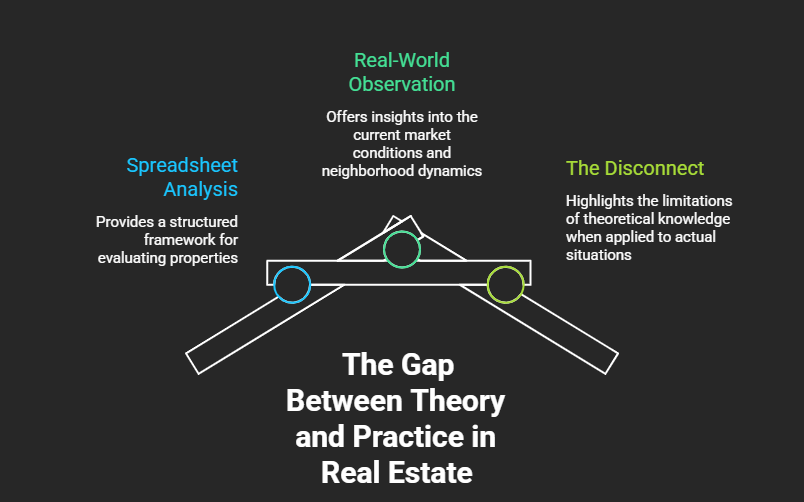
You find a course. You watch the modules. You run the numbers on a spreadsheet that looks clean and logical. And then you stand in front of an actual property in a neighborhood you sort of recognize and realize the spreadsheet has nothing to say about what’s happening on that street right now.
That’s where most beginners get stuck. Not because they didn’t study. Because studying alone isn’t enough.
Online real estate investing courses have real value – and real limits. Knowing which is which is actually where real estate investing for beginners starts.
What Online Real Estate Investing Courses Actually Do Well
A solid real estate investing course handles the foundation well. Cap rates, cash-on-cash return, deal analysis basics, and how different financing structures work – all of this can be taught online, and flexibility matters when you’re balancing a full-time job and a family. You should not walk into your first deal without understanding these fundamentals.
For property investment for beginners, the concepts aren’t complicated once they’re explained properly. The confusion usually comes from trying to learn them in isolation, with no one to confirm you’re applying them correctly to a real situation.
So yes, use a course. Use it to build your vocabulary and get comfortable with the numbers. Then understand what comes next.
Where Online Courses Hit a Wall
Here’s what no recording can give you: a lender who actually closes investment loans in South Florida. A contractor in Broward County who shows up when they say they will. Knowledge of what property insurance genuinely costs for a single-family home in Miami-Dade right now – not last year, not in a case study from another market.
Real estate investment classes built around national templates don’t account for zip-code-level variation. A deal that looks clean on paper in one part of Fort Lauderdale can look completely different two miles away. You can’t model that from a course. You get it from someone who has already learned it the hard way in your market.
This is the ceiling every beginner hits if they rely only on online real estate investing courses to get ready. The concepts are transferable. The context is not.
How To Begin Investing In Real Estate Without Getting Stuck in Prep Mode
Most people don’t fail at real estate investing because they don’t know enough. They get stuck because they keep preparing to be ready instead of putting themselves in rooms where they can actually move forward.
How to begin investing in real estate comes down to one shift: stop consuming content alone and start getting access to people who are doing active deals in your specific market. Someone who bought on a similar street six months ago can ask two questions that change how you see a deal entirely. That kind of input doesn’t exist in a course module. It exists in a room.
Real estate investing programs that combine education with community close this gap in a way that self-directed learning cannot. The goal isn’t to replace the course – it’s to make sure you’re not the only person evaluating your assumptions before you commit real money.
What a Real Estate Coaching Program Should Actually Look Like
There’s a version of a real estate coaching program that sells you a five-step formula and calls it coaching. Any program that frames it that way is not being straight with you.
Real coaching means sitting with you on a specific deal. Asking hard questions about numbers you haven’t tested. Pushing back on an assumption that sounds reasonable until someone with experience points out what it’s missing. The goal is to build your judgement so you can make better calls on your own — not to keep you dependent on a program forever.
Latin REIA’s real estate investing programs are built around this. Classes built around what investors in Miami-Dade, Broward, and Palm Beach are actually dealing with right now. Real estate wholesaling mentorship run by practitioners who are actively sourcing deals – not instructors who studied wholesaling theoretically. And for investors ready to get into fix-and-flip, guidance from people who have actually renovated properties in this market.
Real Estate Investing Courses and Community: Why You Need Both
The investors who move fastest aren’t the ones who took the most courses. They’re the ones who combined a solid real estate investing course with access to a community of people doing deals in the same market.
That’s not a knock-on education. It’s an honest description of how the learning actually works. You build the framework through a course. You build judgement through people.
Cómo Invertir en Bienes Raíces – learning to invest in real estate – is something Latin REIA does in both English and Spanish. The community we serve deserves to learn in the language they actually think in, with context that reflects the market they’re actually investing in.
If you’ve been sitting on the prep side of real estate investing for longer than you expected, the issue probably isn’t the quality of your courses. It’s that you haven’t had the right people around you when it counts.

One Response