If you’re searching for real estate training in Florida, you’ve probably already noticed the problem: there are dozens of options, and almost none of them tell you which one actually fits where you are right now. At Latin REIA, we work with new and experienced investors across Broward, Miami-Dade, and Palm Beach counties every week, and the question we hear most often isn’t “which course is best” – it’s “which format even makes sense for me?”
That question matters because real estate investing training in Florida isn’t a single product – it’s a category that includes self-paced online courses, live classes, 1-on-1 coaching, and community-based learning, each solving a different problem at a different stage of your investing journey. Choosing the wrong format at the wrong time is one of the most common reasons new investors spend money on education and still feel stuck.
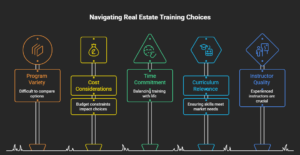
This guide walks through every legitimate way to learn real estate investing in Florida, how to evaluate a program before you spend a dollar, and how to match your stage to the right next step – whether that’s your first class, your first course, or your first coaching call.
What “Real Estate Investing Training” Actually Means in Florida
Real estate investing training is any structured education – a class, course, coaching relationship, or community – that teaches you how to find, finance, analyze, and manage investment properties. It is distinct from real estate sales training, and in Florida, that distinction matters more than in most states because the two paths have entirely different requirements, different costs, and different end goals.
Good real estate education Florida programs share a few traits regardless of format: they’re taught by someone actively doing the work, they address the state-specific factors that change your numbers, and they don’t leave you on your own the moment the material ends. Keep those three traits in mind as you read through the rest of this guide – they’ll come up again in the evaluation section below.
Investing Training vs. Real Estate Agent Licensing – Don’t Confuse These
This is the single most common point of confusion we see at Latin REIA. Becoming a licensed real estate agent in Florida requires state-approved pre-licensing coursework and passing a state exam through the Florida Department of Business and Professional Regulation (DBPR). Becoming a real estate investor, on the other hand, does not require a license at all. You can buy, hold, rent, wholesale, or flip property in Florida without ever sitting for an agent exam.
That doesn’t mean investing training is optional – it means the training you need is different. An investor needs to understand financing, deal analysis, contractor management, and Florida-specific costs like property insurance. An agent needs to understand contract law, fiduciary duty, and MLS practice. Some people benefit from both paths – a number of our members are licensed agents who also invest – but most people who search for real estate investing training in Florida only need the investor-focused path, not a real estate license.
The Four Formats of Real Estate Training Available in Florida
Florida investors generally choose from four training formats. None of them is universally “best” – each solves a different problem.
Self-Paced Online Courses
Online courses let you learn on your own schedule, which matters if you’re investing around a full-time job. They work well for building foundational knowledge – deal analysis math, financing structures, key terminology – but they don’t provide feedback on your specific market or your specific deals. Think of a course as the textbook: essential, but not a substitute for practice.
Live Classes & Workshops
In-person classes and workshops add something self-paced courses can’t: a room full of other Florida investors, a chance to ask questions in real time, and exposure to how experienced investors actually talk through a deal. Latin REIA hosts live workshops as part of our regular events calendar for exactly this reason – hearing another investor’s reasoning out loud often clarifies a concept faster than reading about it does.
1-on-1 Coaching & Mentorship
Coaching pairs you with a specific person who reviews your actual deals, your actual numbers, and your actual progress. This is the format with the most accountability, and it’s the one most investors eventually want once they’ve moved past general education and are trying to close a specific deal. Latin REIA’s coaching includes 1-on-1 sessions, a 48-hour deal review, monthly group coaching calls, and weekly accountability check-ins – the kind of structure that keeps momentum going after the initial excitement of “getting started” wears off.
Investor Community / Networking-Based Learning
Community-based learning – regular meetups, member forums, deal-sharing sessions – is often underrated. Much of what experienced investors know was learned informally, from other investors, not from a paid program. A strong local community shortens that learning curve considerably, and it’s usually the lowest-cost, lowest-commitment way to start. Latin REIA’s free membership tier exists specifically for investors who want to start here before deciding whether a paid course or coaching makes sense.
How to Evaluate Any Real Estate Training Program Before You Pay
Whether you’re looking at Latin REIA’s programs or anyone else’s, the same three questions apply.
Who Is Actually Teaching It
Ask who developed the curriculum and who delivers it. Is it a currently active investor, or a marketing team representing a personality who no longer does the work? A program built and taught by someone actively investing in your market carries more weight than a generic national brand.
Does It Cover Florida-Specific Financing and Market Conditions
Florida has real, state-specific factors that change the math on every deal – property insurance costs, flood zone considerations, HOA prevalence in certain markets, and county-by-county price differences between Miami-Dade, Broward, and Palm Beach. A program built for a national audience often glosses over these entirely. A Florida-specific program shouldn’t.
Is There Accountability After the Course Ends
This is the question most people forget to ask. A course can teach you the theory, but investing happens deal by deal, and most new investors get stuck at the point of actually making an offer. Ask directly: what happens after I finish the material? Is there ongoing access to a coach, a community, or a review process – or does support end the day you complete the last module?
If a program can’t answer that question clearly, treat it as a red flag. A program built on real accountability will be specific – naming actual features like deal reviews, group calls, or check-ins – rather than offering a vague promise of “ongoing support.”
Which Training Path Fits Your Stage
Not every investor needs the same starting point. Here’s a simple way to think about it.
Total Beginner
If you’re still learning the vocabulary and the basic mechanics of how a deal works, start with a self-paced course or a live class, and consider joining a free community to start absorbing how experienced investors talk about deals. Your goal at this stage is foundational literacy, not deal execution — resist the urge to jump straight into coaching before you understand what a coach will actually be reviewing.
Ready to Analyze Real Deals
Once you understand the fundamentals and are actively looking at properties, a structured course paired with an investor community gives you both the framework and the peer support to start running real numbers. This is also the stage where Florida-specific factors – insurance costs, county-level price differences, HOA rules – start to matter in a concrete way rather than an abstract one.
Ready for 1-on-1 Accountability
If you’ve analyzed deals before and are ready to move on a specific opportunity, coaching is the format built for you. This is where a coach reviewing your actual numbers — rather than a hypothetical example in a course module – makes the biggest difference. It’s also the point where most investors stop asking “how does this work in general” and start asking “does this specific deal work?”
At Latin REIA, our members move through these stages using our real estate investment classes, our real estate investing course, and our real estate coaching program, all built around the same Florida-specific curriculum and taught by our founder, Antonio Lopez, an active investor and a member of the Broward Real Estate Investors Association (BREIA) since 2012. Latin REIA’s community includes more than 500 active members across Broward, Miami-Dade, and Palm Beach counties, and coaching is available bilingually in English and Spanish.